
Introduction - دانشكده اقتصاد و توسعه كشاورزی - aed
Introduction to the Faculty of Agricultural Economics and Development
The Faculty of Agricultural Economics and Development is one of the four faculties of the College of Agriculture and Natural Resources, University of Tehran. It was established in 2005 following a policy of reform and restructuring within the University of Tehran aimed at expanding and developing academic disciplines. Although the faculty was founded in 2005, the Department of Agricultural Economics and the Department of Agricultural Extension and Education have a long history, having admitted students at various degree levels since the 1960s. Concurrent with the establishment of the Faculty of Agricultural Economics and Development, a new department, the Department of Agricultural Management and Development, was also founded, admitting students at the postgraduate levels (Master's and Ph.D.). The faculty currently offers two undergraduate programs, six master's programs, and four doctoral programs with eight specialized concentrations.
Currently, the Faculty of Agricultural Economics and Development comprises three academic departments: Agricultural Economics (established 1963), Agricultural Extension and Education (established 1971), and Agricultural Management and Development (established 2009).
The faculty's research and scientific centers include: the Agricultural Insurance and Risk Institute, the Cooperative Development Research Institute, the Center of Excellence for Developing Agricultural Development Strategy, and the laboratories for Policy Analysis, Education, and the Innovation and Agribusiness Simulation Lab within the Department of Agricultural Extension and Education. Each of these research centers and laboratories has, to date, carried out or is currently undertaking numerous scientific-research projects in collaboration with executive organizations.
Given that Iran's agricultural higher education system faces fundamental challenges including declining applicant interest, a disconnect between academia and the real needs of the agricultural sector, and weak graduate employment prospects, all of which pose a serious threat to the viability of agricultural disciplines, this faculty, in late 2025, initiated the development of a strategic transformation document for the Faculty of Agricultural Economics and Development, with a vision toward the 2034. Details are provided in the Strategic Plan section.
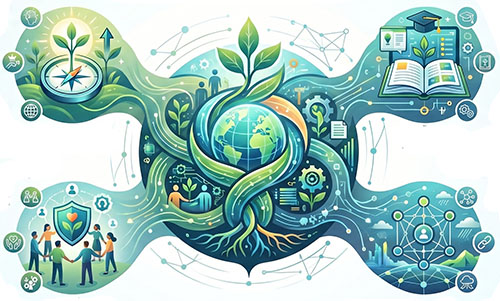
This necessity is particularly underscored by the fact that the issue of sustainability in agricultural higher education has been examined by researchers in this field for nearly four decades. Furthermore, the global agricultural paradigm has shifted from "mere production" to "knowledge management and innovation systems." By integrating global experiences and localizing them based on Iran's institutional realities, this document provides a roadmap for transitioning from a "teaching and research-oriented faculty" to an "innovation and social learning ecosystem." Based on the new paradigm of achieving advanced, climate-smart agricultural indicators internationally; today's world of agriculture is not solely about 'production,' but rather the realm of 'knowledge management,' 'technological innovations,' and 'complex social systems.' In response to this paradigm shift and with the aim of transitioning from a traditional educational unit to a 'learning and innovation ecosystem,' and also considering the strategic plan with a vision toward 2034 for the College of Agriculture and Natural Resources, University of Tehran, the faculty has defined this plan in four chapters.
Introduction to the Academic Departments:
A) Department of Agricultural Economics:
The Department of Agricultural Economics is one of the longstanding pillars of the College of Agriculture and Natural Resources, University of Tehran, having commenced its educational activities at the undergraduate level in 1963. Through continuous scientific development, it has been admitting students to its Master's program since 1971 and to its Ph.D. program since 1994. Our ultimate goal is to align with the country's development visions by training specialized, efficient, and entrepreneurial professionals. In this department, students learn to apply the principles and fundamentals of economics to areas such as agribusiness and trade, product marketing, policy-making, production management, and environmental economics. Emphasizing advanced quantitative and qualitative methods, we aim to develop economic theories and provide practical recommendations to policymakers. Our research focuses on contemporary challenges, including reforming government support policies, improving market efficiency, promoting sustainable development, preserving environmental quality, and enhancing economic welfare.
B) Department of Agricultural Extension and Education:
This department was established in 1971 following the ratification of the charter for the Agricultural Extension and Education unit, and the first graduates of the Bachelor's program in Agricultural Extension and Education entered the job market in 1975. The Master's program in Agricultural Extension and Education was launched in 1985. In 1995, the Ph.D. program in Agricultural Extension and Education was approved by the Doctoral Committee of the University of Tehran's Faculty of Agriculture. The department's missions include enhancing the knowledge, insight, and skills of candidates for higher education in the field of Agricultural Extension and Education, aimed at the comprehensive development of agriculture and rural society in Iran. The goal is to produce creative, entrepreneurial, capable, and intellectually independent graduates who can be effective agents of service in society. Additionally, conducting fundamental and applied research, as well as adaptation and developmental research to produce science and technology in relevant fields, disseminating it in society, and providing extra-university training to target audiences and interested individuals are among the other missions of the Department of Agricultural Extension and Education.
C) Department of Agricultural Management and Development:
The Department of Agricultural Management and Development was proposed concurrently with the establishment of the Faculty of Agricultural Economics and Development in 2004, officially founded in 2009, and is housed in the new building of the faculty. Developing the insight, knowledge, and skills of human resources for globalization, combating global warming, and taking necessary actions to achieve sustainability in development are fundamental challenges of the 21st century. Addressing these challenges requires the development of systemic thinking, 'soft' movements (cultural/intellectual shifts), adherence to and improvement of sustainable development indicators along with environmental characteristics, which in turn necessitates the expansion of comprehensive, systemic, and scientific management. The Department of Agricultural Management and Development was established in line with these new and essential approaches of the third millennium. Considering the requirements for the optimal utilization of various resources, including production inputs and human resources, the department's core mission is to advance knowledge and elevate the scientific standing of students in these areas. This mission is pursued by providing educational opportunities for students in three programs across two degree levels: Agricultural Management and Rural Development at the Master's level, and Agricultural Development at the Ph.D. level.